
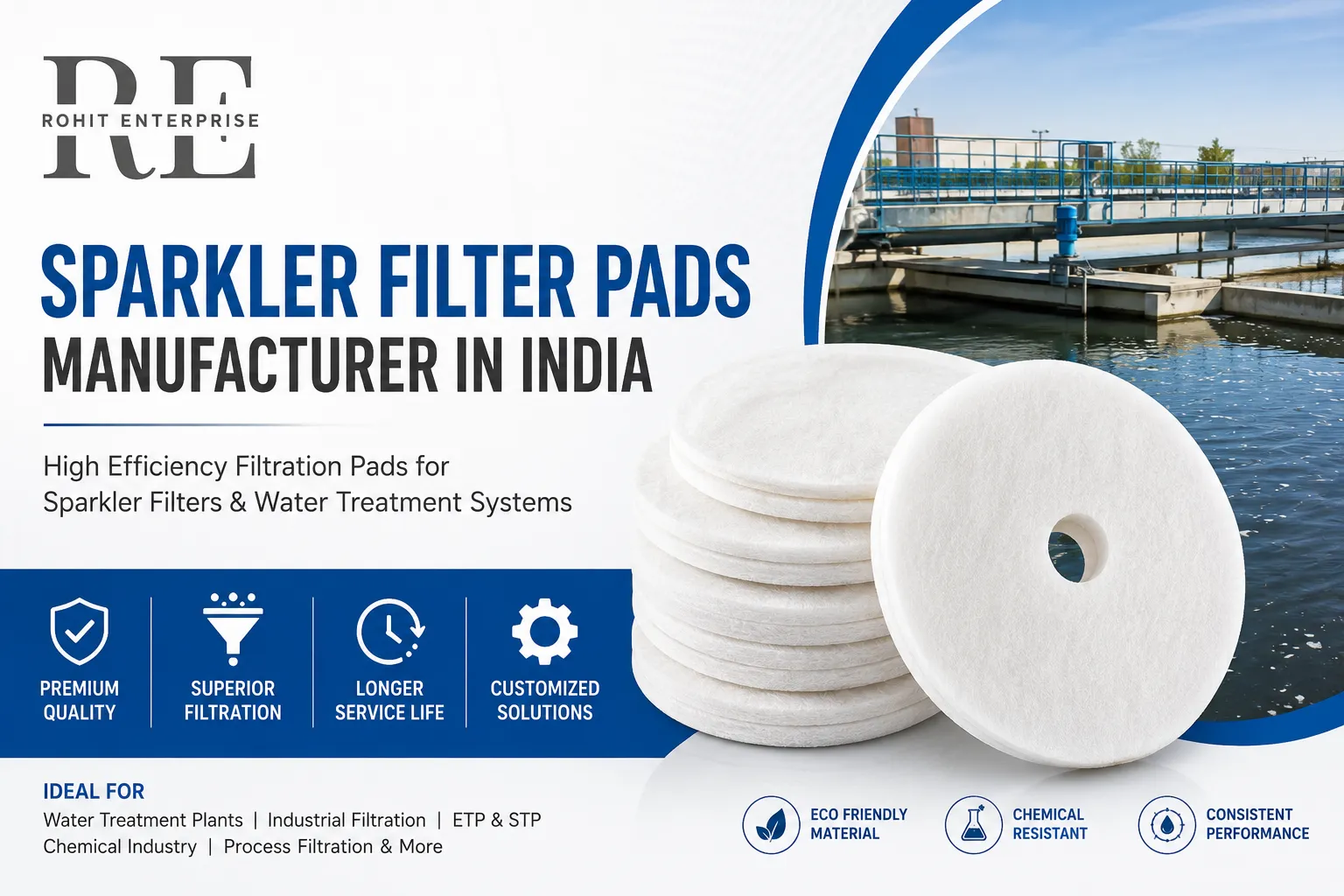
Sparkler filter pads are the working media inside horizontal plate filters used across pharmaceutical, chemical and beverage plants. When pad quality varies, filtrate clarity drops, cycle times increase and batches get delayed. As a specialised sparkler filter pads manufacturer in India, Rohit Enterprises has been supplying depth cellulose filter pads and sterilised sparkler filter pads since 1998 from our facility in Ankleshwar, Gujarat. We focus on pads that deliver consistent particle retention, reliable flow rates and clear filtrate under actual process conditions.
Plant teams running Sparkler-type filters know that thickness, wet strength, porosity and surface finish determine how long a pad lasts and how clear the final liquid becomes. That practical performance is what we engineer into every batch.
Sparkler filter pads sit on the horizontal filter plates inside a Sparkler-type pressure filter. Contaminated liquid is pumped into the vessel and spreads across the top of each plate. The pad retains solids while allowing clear filtrate to pass through the central channel formed by interlocking cups and exit the filter.
Unlike surface filters that capture particles only on the outer layer, these pads operate on depth filtration. Particles are trapped throughout the thickness of the media. This gives higher dirt-holding capacity and longer filtration cycles before the pressure drop rises sharply. Depth filtration retains particulate matter throughout the depth of a porous medium, enabling separation across a broad range of particle sizes, as explained in technical literature on depth filters.
Inconsistent porosity causes early blinding or particle breakthrough. Weak wet strength leads to pad disintegration under pressure. Poor edge finishing allows bypass. These problems increase cleaning frequency, raise product loss and create contamination risk in regulated processes. A correctly made pad removes those variables.
Rohit Enterprises manufactures all grades of depth cellulose filter pads and sterilised cellulose sparkler filter pads, available with or without wet strength. Pads can be pure cellulose or blended with diatomaceous earth for improved flow and clarity. Sterilised versions are offered for pharmaceutical and sterile process applications.
Standard cellulose pads suit many chemical and intermediate filtrations. Wet-strength versions maintain mechanical integrity when filtering aqueous or high-moisture liquids under pressure.
Sterilised cellulose sparkler filter pads are supplied for processes that require controlled bioburden or documented cleanliness. These are handled and packed under controlled conditions.
We start with the filter model, plate diameter and the nature of the liquid being filtered. Thickness, GSM, porosity and surface finish are then matched to the solids loading and desired filtrate clarity.
Pads are cut in standard diameters used in Sparkler filters — 8.5″, 12″, 14.5″, 15.5″, 18.5″, 19″ and other sizes as required. Both round and square formats can be supplied. Thickness typically ranges from 1.5 mm to 4.5 mm depending on the grade and application.
Edges are finished cleanly so the pad seats properly on the plate without fraying or fibre release. Surface uniformity is controlled to avoid preferential flow paths that reduce effective filtration area.
Every production lot is checked for thickness, basis weight and basic filtration performance. This reduces the variation that operators notice when switching between different suppliers.
Longer filtration cycles are the most immediate gain. A pad with the right porosity and dirt-holding capacity runs longer before differential pressure rises. This means fewer change-outs and less operator time spent opening and cleaning the filter.
Consistent particle retention protects product quality and reduces the need for re-filtration. Cleaner filtrate also lowers the load on downstream polishing steps when they are used.
Fewer pad changes, reduced product loss during cleaning and more predictable cycle times all contribute to lower total cost of filtration. Even when the unit price of a better pad is slightly higher, the overall economics usually improve.
Our process begins with understanding the liquid, solids load, temperature and any special requirements such as sterilisation or wet strength. Raw cellulose and blending materials are selected accordingly.
Pads are produced under controlled conditions to maintain uniform thickness and porosity. Finished pads are inspected for dimensional accuracy and visual defects before packing. For regulated customers we provide necessary documentation and batch identification.
Non-standard diameters, special thicknesses or specific wet-strength formulations are produced regularly. We treat these as normal production rather than special projects that delay supply.
Pharmaceutical plants use sparkler filter pads for clarification of syrups, intermediates, active ingredients and process liquids. Sterilised grades are preferred where bioburden control is required.
Chemical units filter catalysts, activated carbon, resins, intermediates and various process streams. Pads must resist the chemical environment and maintain structure under pressure.
Breweries, syrup manufacturers, edible oil processors and similar plants rely on these pads for clear filtrate and consistent product appearance. Wet-strength versions perform better with aqueous liquids.
Transformer oil filtration, charcoal and catalyst recovery, and certain cosmetic process streams also use sparkler filter pads when high clarity and reliable particle retention are needed.
We ask for the filter size, liquid characteristics, solids loading and current problems. That information lets us recommend the right grade instead of offering a generic stock pad.
Quality is judged by how the pad performs across multiple cycles, not by marketing claims. Material certificates and batch details are provided when required by the customer’s quality system.
Lead times are stated clearly. Technical discussion covers wet strength, sterilisation needs and expected cycle life so the plant can plan change-outs properly.
Provide the Sparkler filter model or plate diameter, the liquid being filtered, approximate solids content, temperature, and whether wet strength or sterilisation is required. Note any issues with current pads such as short life, poor clarity or disintegration.
Sample pads can be supplied for process trials when needed. Once the grade is confirmed, regular supply is arranged with clear packaging and identification.
A reliable sparkler filter pads manufacturer in India is defined by how consistently the pads perform inside working Sparkler filters, not by catalogue descriptions. Rohit Enterprises has focused on depth cellulose filter pads and sterilised sparkler filter pads since 1998. From standard cellulose grades to wet-strength and sterilised versions, the goal remains the same: clear filtrate, predictable cycle life and reduced process interruptions.
If your current pads are limiting filtration time, giving variable clarity or failing under pressure, send the process details. We will respond with a clear technical recommendation and a straightforward commercial offer.
Rohit Enterprises is located in the industrial city of Ankleshwar in hearts of Gujarat. Established in the year 1998. jarat. Founded by Mr. Chandan Singh Kokliyal