
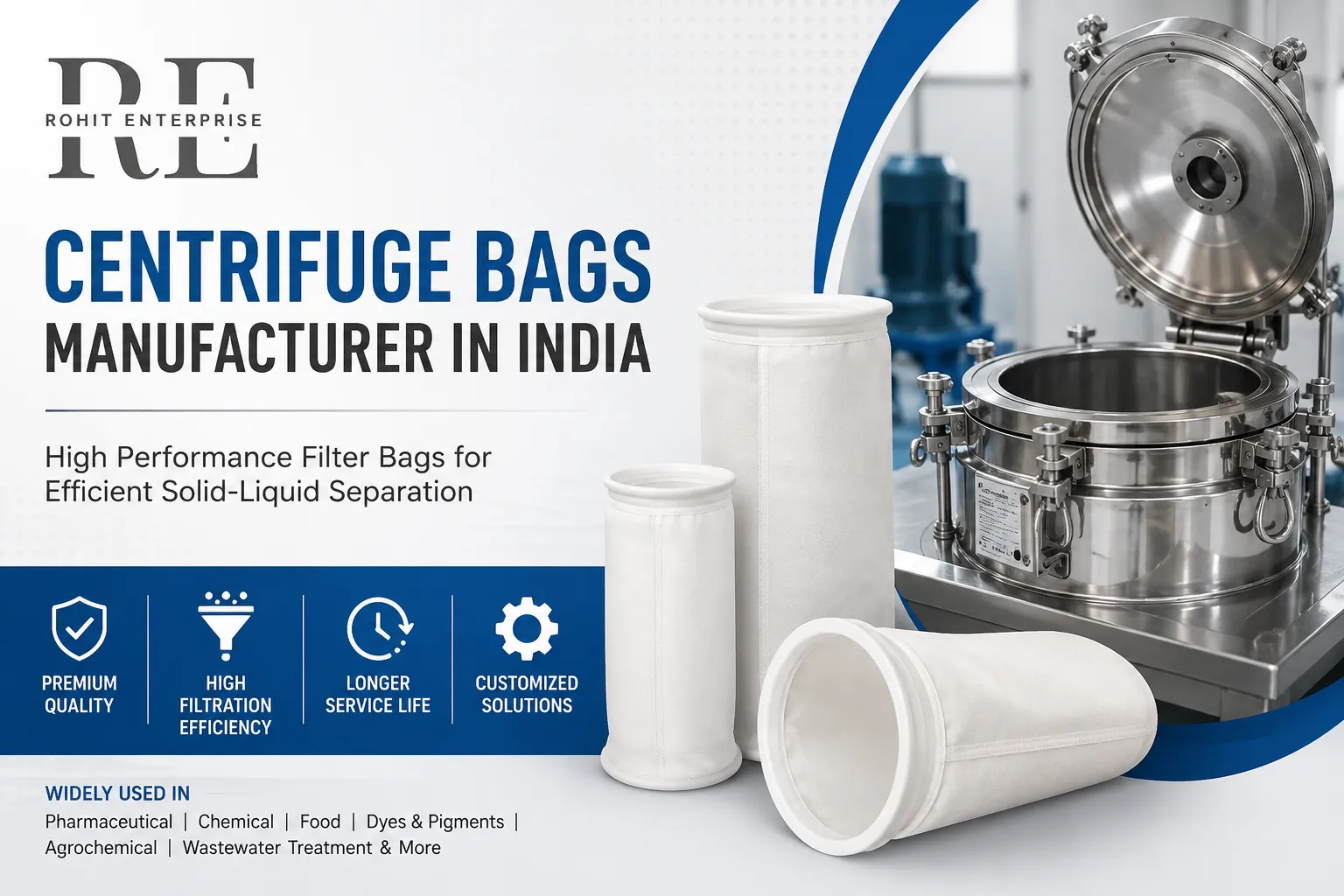
A centrifuge bag is the working surface that separates solids from liquids under high rotational force. When the bag fails—seams open, fabric blinds, or cake will not release—the entire batch suffers. As a specialised centrifuge bags manufacturer in India, Rohit Enterprises has been producing these bags for process plants since 1998 from our facility in Ankleshwar, Gujarat. We focus on bags that match the exact geometry of the machine and the chemistry of the slurry, so filtration stays consistent and downtime stays low.
Plant engineers who run bag-lifting, basket or peeler centrifuges know that not every filter fabric behaves the same under load. Pore structure, seam strength, surface finish and dimensional accuracy decide how clean the filtrate is, how dry the cake becomes, and how many cycles the bag survives. That is the practical problem we solve every day.
A centrifuge bag is a precision-fitted filter medium placed inside the rotating basket. As the machine spins, centrifugal force drives the liquid through the fabric while solids form a cake on the surface. The bag must hold its shape at high RPM, resist chemical attack, allow controlled permeability, and release the cake cleanly when the cycle ends.
Basket centrifuges, often called centrifugal filters, rely on a perforated wall and a fitted filter medium to retain solids while allowing liquid to pass. This principle of centrifugal filtration is well established in industrial process engineering, as outlined in technical overviews of centrifuge technology published by Encyclopaedia Britannica.
Poor construction shows up quickly. Uneven pores cause bypass. Weak seams open under the weight of wet cake. Rough surfaces hold residual heel and force extra cleaning. These issues raise maintenance costs and risk product contamination, especially in regulated industries. A correctly engineered bag removes those variables.
Rohit Enterprises manufactures bags from polypropylene, polyester, nylon and PTFE. Each material is selected for the specific process conditions—temperature, pH, solvent presence and particle size. Fabrics can be monofilament, multifilament or spun, with or without antistatic treatment. Surfaces are calendered or singed when easier cake discharge is required. Pharma-grade materials with full traceability are available when documentation is mandatory.
Polypropylene remains the first choice for most chemical and pharmaceutical applications because of its broad resistance profile. Polyester is preferred when moderate heat and higher mechanical strength are required.
Nylon offers superior abrasion resistance and smoother cake release. PTFE is reserved for the most aggressive chemical environments where other polymers degrade too quickly.
We start with the basket dimensions and the discharge method. Fabric selection, cutting accuracy and seam construction are adjusted according to the machine type and the slurry characteristics.
Bag-lifting designs receive reinforced collars and lifting loops sized for the full wet-cake weight. The top section is built to withstand repeated lifting cycles without elongation or distortion.
Basket-type bags are cut to sit flush against the wall so slurry cannot bypass the edge. Edge finishing and dimensional control are critical here to maintain full filtration area throughout the cycle.
For peeler centrifuges we often use double-layer weave or separate backing cloths that tolerate scraper contact without tearing or excessive wear. Calendered surfaces help reduce residual heel and shorten cleaning time.
Seams are stitched or, where the fabric allows, welded to eliminate particle traps and weak points. Fabric tension is controlled during fabrication so the finished bag does not wrinkle or fold once installed. These details sound minor until a bag distorts after a few cycles and filtration area is lost.
Micron ratings and permeability are matched to the solids loading. Too open and fines pass through. Too tight and the bag blinds early. We adjust both to the actual slurry rather than forcing a standard stock item onto every machine.
Longer bag life is the most visible gain. A bag that lasts through more cycles reduces change-out frequency and the labour that goes with it.
Cleaner cake discharge shortens the residual heel removal step and cuts the volume of wash liquid needed. Consistent filtrate quality protects downstream equipment and product purity targets.
Downtime drops because bags fit correctly the first time. There is less trial-and-error with oversized or undersized media. Chemical resistance matched to the process means fewer premature failures from fabric degradation. Over a year these factors lower the total cost of filtration even when the unit price of the bag is not the lowest in the market.
Our process begins with fabric selection based on the data the customer supplies—machine type, RPM range, slurry chemistry, particle size and current failure modes.
Cutting is done to the measured basket dimensions rather than rounded standard sizes. Sewing and finishing follow fixed work instructions so every bag in a batch performs the same.
Quality checks cover dimensional accuracy, seam integrity and surface finish before packing. For regulated customers we supply material certificates and batch identification. The facility operates under an ISO 9001:2015 certified quality management system.
Customisation is routine. Older or non-standard centrifuges often need special flange designs, integrated support layers or unusual lifting arrangements. We produce those without treating them as special projects that delay delivery.
Pharmaceutical and bulk-drug plants form a large part of the demand. Bags must meet hygiene and documentation expectations while handling intermediates that range from sticky to crystalline.
Chemical and specialty chemical units need resistance to aggressive solvents and wide pH swings. Dye and pigment manufacturers process high-solids slurries that demand strong cake retention and clean discharge.
Food-related processes, certain agrochemical steps and industrial wastewater recovery also use these bags when solid recovery or filtrate clarity is required. In each case the common thread is centrifugal solid-liquid separation under conditions that punish generic filter media.
Experience shows in the questions we ask. We want the machine make and model, the typical cycle parameters and the problems the current bags create. That information lets us recommend a construction that addresses the real constraint rather than a catalogue default.
Quality is measured by how the bag behaves after repeated cycles, not by marketing claims. Customisation is offered because many Indian plants run a mix of new and older equipment that rarely matches one-size-fits-all dimensions. Technical support means we discuss fabric options and surface finishes with the people who actually run the centrifuges.
Pricing stays competitive for the performance delivered, and delivery schedules are stated clearly so production planning is not disrupted. Customer satisfaction comes from bags that install without drama and run without unexpected failures. We do not publish inflated numbers of clients or export destinations. The record is simply the repeat orders from plants that have used the bags over multiple years.
Provide the centrifuge type and basket size, the nature of the slurry, the temperature and any solvents present, and the discharge method. Note any recurring issues with existing bags—early blinding, seam failure, poor cake release or short life.
With that information we can propose a fabric, construction and surface finish, supply samples when needed, and quote realistic lead times. This practical exchange is how most of our long-term relationships begin.
A reliable centrifuge bags manufacturer in India is defined by how well the product survives the conditions inside a working centrifuge, not by the length of a brochure. Rohit Enterprises has focused on that single requirement since 1998. From pharma-grade polypropylene bags for bag-lifting machines to specialised PTFE liners for aggressive chemical streams, the goal remains the same: consistent filtration, predictable cake discharge and longer service intervals.
If your current bags are limiting throughput, creating extra cleaning work or failing earlier than expected, send the process details. We will respond with a clear technical recommendation and a straightforward commercial offer.
Rohit Enterprises is located in the industrial city of Ankleshwar in hearts of Gujarat. Established in the year 1998. jarat. Founded by Mr. Chandan Singh Kokliyal