
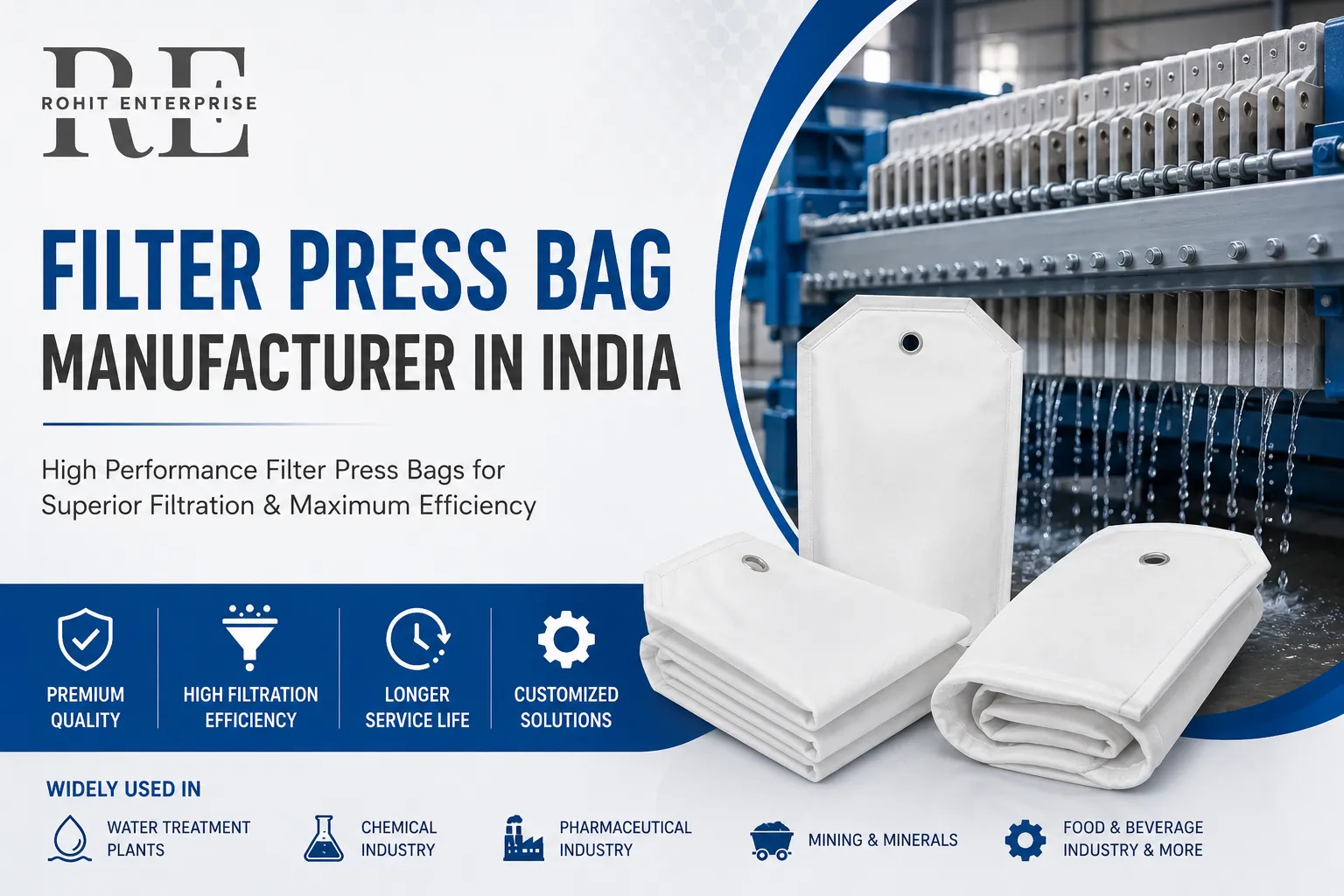
Filter press bags (also called filter press cloths or filter panels) are the primary media that separate solids from liquids under high pressure inside chamber and membrane filter presses. When the cloth does not fit correctly, blinds early, or tears at the edges, cycle times increase, cake moisture rises and filtrate quality suffers. As a specialised filter press bag manufacturer in India, Rohit Enterprises has been producing custom filter press fabrics since 1998 from our facility in Ankleshwar, Gujarat. We focus on cloths that deliver consistent particle retention, good cake release and long service life under real process conditions.
Plant engineers who run filter presses know that fabric selection, weave, GSM and edge finishing decide how clean the filtrate is, how dry the cake becomes and how many cycles the cloth survives. That practical performance is what we engineer into every order.
A filter press bag or cloth is fitted onto the recessed or membrane plates of a filter press. Slurry is pumped into the chambers under pressure. The liquid (filtrate) passes through the cloth while solids form a cake on the surface. At the end of the cycle the plates open and the cake is discharged.
Filter presses rely on pressure-driven filtration through a porous textile medium. The cloth must withstand high differential pressure, resist chemical attack and allow controlled permeability so that filtrate flow remains acceptable while solids are retained. This principle of solid-liquid filtration using pressure filters is a well-established unit operation in process industries, as detailed in technical literature on solid-liquid filtration.
Poor dimensional accuracy causes leakage around the edges. Incorrect porosity leads to early blinding or particle breakthrough. Weak mechanical strength results in tears at the feed hole or sealing edges. These problems increase downtime, raise wash water consumption and reduce overall throughput. A correctly engineered filter press bag removes those variables.
Rohit Enterprises manufactures filter press bags and cloths from polypropylene, polyester, nylon and selected non-woven constructions. Each material is chosen according to the chemical nature of the slurry, operating temperature and mechanical demands of the press.
Polypropylene is the most widely used material because of its excellent chemical resistance to acids, alkalis and many organic solvents. It is lightweight, easy to clean and cost-effective for a broad range of chemical and wastewater applications.
Polyester offers higher temperature resistance and good abrasion resistance. Nylon provides superior mechanical strength and flexibility, making it suitable for applications that demand fine particle retention or frequent cake discharge.
We start with the plate size, feed arrangement (centre or corner feed), gasket style and the characteristics of the slurry. Weave type, GSM, surface finish and edge construction are then matched to those requirements.
Cloths are produced for common plate sizes and can be supplied as drape-over, butterfly (with sleeves or barrel necks), CGR (caulked gasketed recessed) or gasketed styles. Centre-feed and corner-feed designs are available. Edges can be stitched, welded or finished with Velcro, depending on the plate design and customer preference.
Calendered or singed surfaces improve cake release and reduce residual heel. This shortens the discharge cycle and reduces the volume of wash liquid required. Smooth surfaces also help prevent particles from embedding deeply into the fabric.
Precise cutting ensures the cloth seats correctly on the plate without wrinkles or gaps. Reinforced feed holes and strong edge seams prevent tearing under repeated high-pressure cycles. These details extend cloth life and maintain consistent filtration performance.
Longer cloth life is the most visible benefit. A well-matched fabric lasts through more cycles before blinding or mechanical failure occurs. This reduces the frequency of change-outs and the labour associated with them.
Correct porosity and surface characteristics help achieve lower residual moisture in the cake and clearer filtrate. Better cake dryness reduces disposal costs and improves handling. Clearer filtrate protects downstream processes.
Cloths that fit correctly and release cake cleanly shorten cycle times and minimise unplanned stoppages. Over a full year these factors lower the total cost of filtration even when the unit price of a higher-quality cloth is not the lowest available.
Our process begins with the plate drawings or samples, slurry data and any specific problems the plant is currently facing. Fabric is selected and cut to the exact dimensions required.
Sewing, welding and edge finishing follow fixed procedures so that every cloth in a batch performs consistently. Finished cloths are checked for dimensional accuracy, seam integrity and surface finish before packing. For regulated customers we supply material certificates and batch identification when required.
Many Indian plants operate older or non-standard filter presses. We regularly produce cloths with special feed hole positions, unusual plate sizes or specific fastening methods without treating them as special projects that delay delivery.
Chemical plants filter dyes, pigments, intermediates, catalysts and various process slurries. Cloths must resist aggressive chemicals and maintain structure under high pressure.
Pharmaceutical units use filter press cloths for clarification and recovery of active ingredients and intermediates. Cleanability and consistent performance are essential.
Effluent treatment plants, mining operations and mineral processing units rely on filter press bags for sludge dewatering and solids recovery. Abrasion resistance and good cake release are critical in these applications.
Certain food and beverage processes, paint and coatings plants, and ceramic or pigment manufacturers also use filter press cloths when high solids recovery and clear filtrate are required.
We ask for plate size, feed type, slurry characteristics and current cloth problems. That information allows us to recommend a fabric and construction that addresses the real constraint rather than offering a generic stock item.
Quality is measured by how the cloth performs after repeated cycles, not by marketing claims. Technical discussion covers weave options, surface finishes and expected life so the plant can plan maintenance properly.
Lead times are stated clearly. Pricing remains competitive for the performance delivered. Customer satisfaction comes from cloths that install without drama and run without unexpected failures.
Provide the plate size and type (recessed, membrane or CGR), feed arrangement, slurry characteristics (solids loading, particle size, pH, temperature, chemicals present), and any problems experienced with existing cloths such as early blinding, poor cake release or edge tearing.
Sample cloths can be supplied for process trials when needed. Once the construction is confirmed, regular supply is arranged with clear identification and packaging.
A reliable filter press bag manufacturer in India is defined by how consistently the cloth performs inside working filter presses, not by catalogue descriptions. Rohit Enterprises has focused on industrial filter cloths and filter press bags since 1998. From polypropylene cloths for chemical and wastewater applications to polyester and nylon constructions for higher temperature or abrasive duties, the goal remains the same: clear filtrate, dry cake, predictable cycle life and reduced process interruptions.
If your current filter press bags are limiting throughput, giving high cake moisture or failing earlier than expected, send the process details. We will respond with a clear technical recommendation and a straightforward commercial offer.
Rohit Enterprises is located in the industrial city of Ankleshwar in hearts of Gujarat. Established in the year 1998. jarat. Founded by Mr. Chandan Singh Kokliyal