
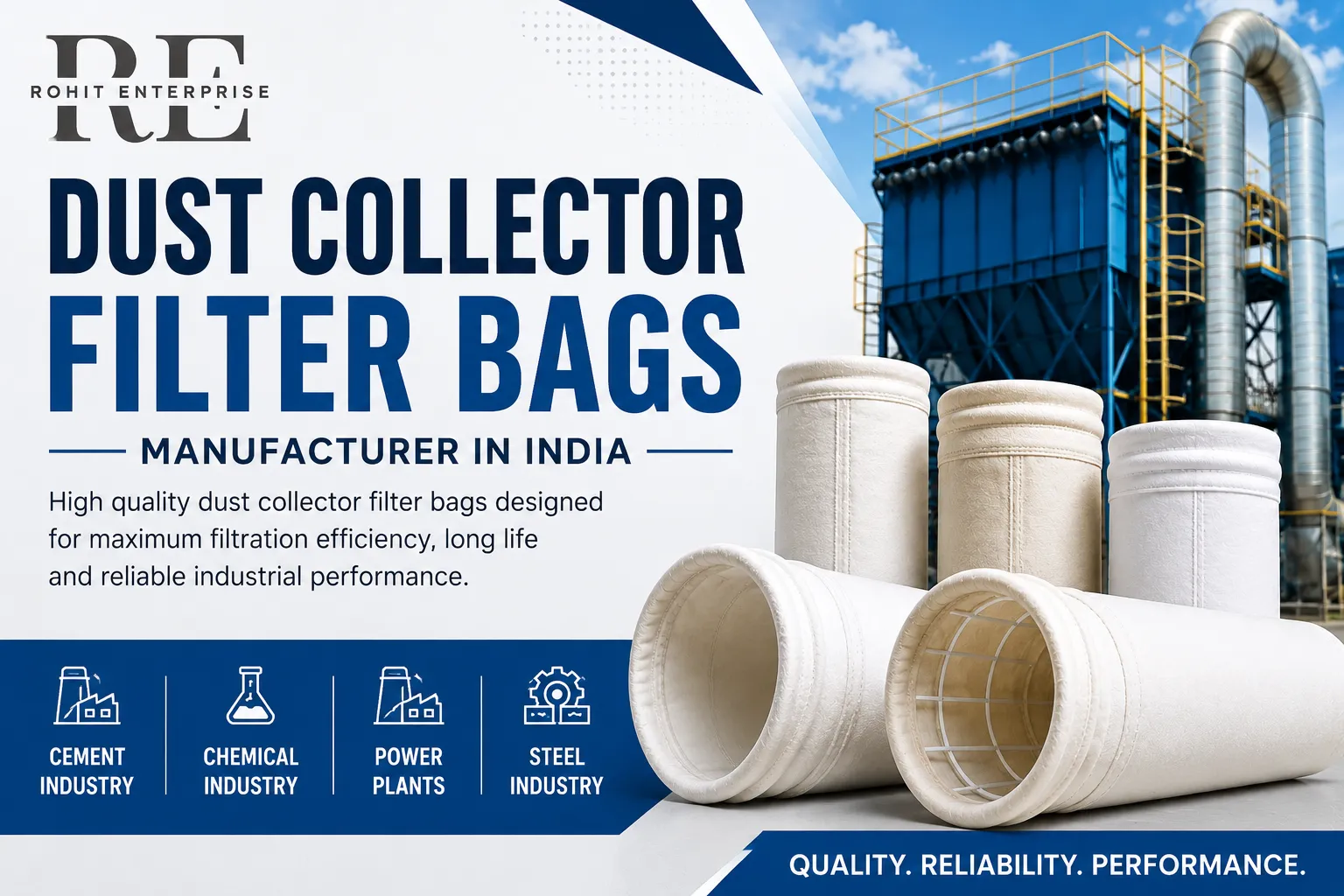
Rohit Enterprises is an experienced dust collector filter bags manufacturer in India, supplying custom filter bags and industrial filtration media for baghouse and dust-collection systems. Since 1998, we have been manufacturing from Ankleshwar, Gujarat, with a focus on filtration performance, dust release, dimensional accuracy, seam strength and dependable service life.
For a plant engineer, choosing a filter bag is not simply a matter of selecting a fabric. The bag has to work with the collector design, cage dimensions, cleaning mechanism, dust characteristics, operating temperature and chemical environment. A mismatch can result in high differential pressure, poor dust release, premature bag failure or unstable emissions.
Our approach is therefore application-focused: understand the operating conditions first, then select the fabric, construction and finish that suit the collector.
Dust collector filter bags are textile filtration elements installed inside industrial baghouse systems to separate dust and particulate matter from process air or gas. The bags are fitted over support cages or installed according to the collector design. Contaminated air passes through the filter media, while particulate matter is retained by the fabric and the dust cake that develops on its surface.
After the dust layer builds up, the collector uses a cleaning mechanism such as pulse-jet, reverse-air or mechanical shaking to remove the accumulated dust into the hopper. The cycle then repeats.
This means the filter bag has two important jobs: it must capture particulate matter efficiently and continue allowing sufficient airflow after repeated cleaning cycles. The U.S. Environmental Protection Agency explains that fabric filters, commonly called baghouses, collect particles by passing the gas stream through fabric filter media and that the dust layer contributes significantly to fine-particle collection.
For technical background on baghouse operation and performance indicators, see the U.S. Environmental Protection Agency’s fabric filter guidance.
A clean filter fabric is not necessarily the final filtration condition. As operation begins, particles accumulate on the media and form a dust cake. This cake can improve fine-particle capture, but excessive accumulation increases resistance to airflow.
The objective is therefore controlled dust-cake formation followed by effective cleaning. A suitable fabric and surface finish should release the cake without excessive residual dust remaining on the media.
If cleaning is too aggressive, the bag may experience unnecessary mechanical stress. If cleaning is insufficient, pressure drop can progressively increase. Proper bag selection has to balance filtration, permeability, cleaning behaviour and mechanical durability.
The filter bag is one of the most important consumable components in a dust-collection system. A dependable dust collector filter bags manufacturer in India should therefore consider the operating environment, not just the bag dimensions. Its construction can influence pressure drop, cleaning frequency, bag life and maintenance requirements.
Common problems associated with poorly matched or poorly constructed bags include:
Rapid increase in differential pressure
Premature fabric blinding
Poor dust-cake release
Seam or cuff failure
Abrasion around the cage
Incorrect fit around the tube sheet
Increased frequency of bag replacement
Unstable outlet emissions
Higher induced-draft fan load
A technically suitable bag does not operate independently of the collector. Air-to-cloth ratio, inlet dust loading, particle characteristics, gas temperature, humidity, cleaning pressure and cleaning frequency also influence performance.
That is why an experienced dust collector filter bags manufacturer in India should evaluate the complete application rather than recommending one standard fabric for every plant.
Rohit Enterprises supplies filter bags using polypropylene, polyester, acrylic, aramid and other technical fabrics according to the application. Fabric selection depends on temperature, chemical exposure, dust characteristics, mechanical requirements and the cleaning system.
Polypropylene (PP) is commonly selected where chemical resistance is important and operating temperatures remain within the suitable range of the material.
PP filter bags can be considered for applications involving many acids and alkalis, including suitable chemical and pharmaceutical dust-collection processes. Their final suitability depends on the actual chemical concentration, temperature and operating conditions.
Polyester (PET) is widely used for general industrial dust collection because it offers a useful combination of mechanical strength, dimensional stability and temperature capability.
Polyester filter bags are commonly considered for cement, minerals, general manufacturing and other applications where operating conditions fall within the fabric’s suitable range.
Acrylic fibres can be selected for applications where the combination of temperature, moisture and chemical conditions makes them appropriate. The correct grade should be determined from the actual process conditions rather than temperature alone.
For demanding high-temperature applications, specialised fibres such as aramid may be considered. The complete gas composition, temperature profile, moisture level and cleaning method should be reviewed before selecting a high-temperature fabric.
Antistatic construction is used where static-charge control is an important part of the application. This can be particularly relevant to combustible dust and powder-handling processes.
Antistatic performance should be selected according to the plant’s process-safety requirements rather than treating it as a universal upgrade. For related information, see our antistatic filter media page.
The correct specification depends on the collector, operating conditions and fabric selected. The following ranges are practical reference points from our standard fabric options; exact suitability should be confirmed for the specific application.
| Parameter | Polypropylene (PP) | Polyester (PET) | Acrylic / Aramid |
|---|---|---|---|
| Typical continuous temperature range | Up to 90°C | Up to 130°C | Approx. 140°C–220°C, application-dependent |
| Typical fabric weight | 350–550 GSM | 400–600 GSM | 450–650 GSM |
| Filtration performance | Application-dependent | Application-dependent | Application-dependent |
| Chemical resistance | Excellent against many acids/alkalis | Good, application-dependent | Application-dependent |
| Antistatic option | Available | Available | Available |
| Typical diameters | 100–300 mm | 100–300 mm | 100–300 mm |
| Typical lengths | Up to 6 m | Up to 6 m | Up to 6 m |
| Top constructions | Snap-band, flange, corded cuff, loop | Snap-band, flange, corded cuff, loop | Snap-band, flange, corded cuff, loop |
These are not universal operating limits. Actual temperature limits, chemical compatibility and filtration performance depend on the selected fibre, construction, finish and process conditions.
For combustible-dust applications, the plant should also review applicable safety requirements, including OSHA’s Combustible Dust hazard overview.
A good filter bag recommendation starts with the operating data. This is where an experienced dust collector filter bags manufacturer in India can add value by matching the media to the collector instead of treating every replacement bag as identical. As a specialised dust collector filter bags manufacturer in India, we consider the following parameters before finalising a construction.
The type of dust affects fabric selection and cleaning behaviour. Important factors include particle size, abrasiveness, moisture, stickiness, concentration and whether the dust is combustible.
Fine particles can behave differently from coarse abrasive dust. Moist or sticky dust may require a different surface finish from a dry, free-flowing material.
Temperature should be evaluated as an actual operating profile rather than a single maximum number. Continuous temperature, peak temperature, temperature fluctuations and the possibility of condensation can all influence fabric selection.
Chemical compatibility is essential in chemical, pharmaceutical and process applications. The gas composition and concentration should be considered together with temperature and moisture.
The cleaning method directly affects the mechanical load placed on the filter bag.
Pulse-jet: compressed-air pulses flex the bags rapidly to remove the dust cake.
Reverse-air: airflow is reversed through the bags to collapse or flex them and release accumulated dust.
Shaker: mechanical movement is used to dislodge the dust cake.
A bag designed for one cleaning environment should not automatically be assumed suitable for another.
Correct dimensions are critical. The bag must fit the cage and tube-sheet arrangement without excessive movement, stretching or interference.
The useful information includes bag diameter, length, cage diameter, cage length, top construction, bottom construction, tube-sheet arrangement and any existing bag drawing.
Filter bag performance depends on more than the fabric. Construction details can determine how securely the bag is installed and how it behaves during cleaning.
Snap-band bags are commonly used in suitable pulse-jet collector designs where the metal ring provides the connection between the bag and tube sheet.
Flange-top designs can be manufactured for collectors using a flange-based connection. The dimensions and sealing arrangement should match the existing collector.
Corded cuffs, loops and other fastening arrangements can be supplied where required by the collector design.
The bottom can be configured according to the cage and collector arrangement. Reinforcement may be used in areas exposed to repeated mechanical stress.
Surface treatment can have a major effect on how dust interacts with the fabric.
Calendering can create a smoother surface that helps reduce dust penetration into the media. Singeing can remove loose fibres from the surface. Other finishes may be selected when specific cake-release or application requirements exist.
The objective is not simply to make the fabric smoother. The finish should be matched to the dust and cleaning system so that the bag can maintain a useful balance between filtration and permeability.
Poor dust release can leave residual material on the fabric. Over time, this can contribute to increasing differential pressure and more frequent cleaning.
Air-to-cloth ratio, also called filtration velocity, is an important parameter in baghouse design and operation. It describes the gas flow relative to the effective filter area.
A high filtration velocity can increase the loading on the media and influence dust-cake formation and pressure drop. A lower velocity may provide more filtration area but can affect equipment size and operating economics.
Pressure drop across the filter is another key performance indicator. A rising differential pressure can indicate excessive dust loading, poor cleaning, fabric blinding or changes in process conditions.
The EPA identifies pressure differential and outlet particulate concentration among important indicators for monitoring fabric-filter performance.
For this reason, changing the filter bag material without considering the collector’s operating conditions may not solve a pressure-drop problem. The root cause should be evaluated.
Pulse-jet systems are widely used in industrial dust collection. Compressed-air pulses periodically clean the bags while the collector continues operating.
The filter fabric must withstand repeated flexing and cleaning cycles. Correct permeability, surface finish, dimensional stability and mechanical construction are important.
Reverse-air collectors clean bags by reversing the airflow. The bag construction must be compatible with the movement and support arrangement used by the collector.
Shaker systems use mechanical movement to release the dust cake. Bag construction and installation need to accommodate the repeated mechanical action.
Rohit Enterprises manufactures industrial filter bags from its facility in Ankleshwar, Gujarat. As a dust collector filter bags manufacturer in India, the manufacturing process is organised around the dimensions and operating requirements supplied by the customer. The manufacturing approach begins with application information such as collector design, cage dimensions, dust type, temperature and cleaning method.
The fabric is selected according to the operating environment. This may include polypropylene, polyester, acrylic, aramid or antistatic construction where appropriate.
Accurate cutting helps maintain dimensional consistency. Sewing and seam construction are important because seams experience repeated stress during installation and cleaning.
Surface finishing is selected according to the required dust-release characteristics and application.
Finished bags are checked for dimensions, construction and visible workmanship before packing. Where required by the customer’s quality process, batch identification and related documentation can be provided.
Dust collection is required across many process industries, but the filtration requirements can vary considerably.
Chemical plants may handle acidic, alkaline or reactive dusts. Chemical compatibility and temperature are important when selecting the fabric.
Pharmaceutical manufacturing can generate fine powders that require controlled dust collection. Fabric selection, surface condition and antistatic requirements may need special consideration.
Cement, mineral and mining processes can generate high dust loading and abrasive particles. Mechanical strength, abrasion resistance, temperature and cleaning conditions become important.
Powder handling can create fine dust and, in certain processes, combustible-dust concerns. Appropriate antistatic construction and plant safety controls should be considered.
Higher-temperature gases and abrasive particulate matter can require specialised filter media. The complete temperature profile and gas chemistry should be reviewed before selecting the fabric.
If pressure drop rises quickly, possible causes include fabric blinding, excessive dust loading, inadequate cleaning, condensation or an operating condition that differs from the original design.
Premature failure may result from abrasion, excessive pulse pressure, incorrect cage alignment, high temperature, chemical attack or poor installation.
If the dust cake remains attached after cleaning, the surface finish, dust characteristics, humidity and cleaning conditions should be evaluated.
Seam failure can occur when the construction is not appropriate for the mechanical stress or when the bag is incorrectly installed.
Unexpected emissions can result from damaged bags, incorrect installation, excessive dust penetration, collector problems or unsuitable media. Bag leakage should be investigated rather than assuming that changing the fabric alone will solve the issue.
When comparing suppliers, look beyond the lowest purchase price. A capable dust collector filter bags manufacturer in India should be able to discuss the technical factors that determine filtration performance and service life. A suitable supplier should be able to discuss:
Filter fabric and fibre type
Operating temperature
Chemical compatibility
Dust characteristics
Cleaning mechanism
Air-to-cloth ratio
Bag dimensions
Cage dimensions
Top and bottom construction
Surface finish
Seam construction
Antistatic requirements
Expected maintenance considerations
Inspection and quality procedures
The right dust collector filter bags manufacturer in India should be able to understand the collector application and explain why a particular fabric or construction has been recommended.
Rohit Enterprises has been involved in industrial filtration since 1998 and supplies custom filter bags for process plants from Ankleshwar, Gujarat.
Instead of treating every order as a standard bag, we review the collector type, cage dimensions, cleaning mechanism, dust and operating conditions before recommending a construction.
Filter bags can be manufactured in required diameters and lengths with suitable top and bottom configurations for existing collectors.
Depending on the application, options can include polypropylene, polyester, acrylic, aramid and antistatic constructions.
Rohit Enterprises operates with an ISO 9001:2015 certified quality system and follows controlled manufacturing and inspection procedures for industrial filtration products.
If you are replacing bags in an existing collector, the most useful starting information is the current bag sample or drawing, cage dimensions, cleaning method, operating temperature, dust type and the reason for replacement.
To receive a technically relevant recommendation, send as much of the following information as possible:
Dust collector make and model
Existing bag dimensions
Cage dimensions
Bag diameter and length
Top and bottom construction
Cleaning method
Operating temperature
Dust type
Dust particle characteristics
Chemical exposure, if applicable
Current filter fabric
Existing pressure-drop or bag-life problem
Required quantity
Drawing or photograph of the existing bag, if available
This information helps the manufacturer identify the appropriate fabric and construction instead of supplying a generic replacement.
Common industrial filter fabrics include polypropylene and polyester, while acrylic, aramid and antistatic constructions can be selected for applications with different temperature, chemical, mechanical or static-control requirements.
Yes. Dust collector bags can be manufactured for suitable pulse-jet systems with appropriate dimensions, top construction, bottom construction, fabric and surface finish.
Yes. Filter bags can be produced for reverse-air and shaker collectors when the collector dimensions and operating conditions are provided.
Yes. Antistatic filter-media options are available for suitable applications where static-charge control is required.
There is no single service-life figure that applies to every bag. Life depends on dust abrasiveness, temperature, chemical exposure, cleaning frequency, cleaning intensity, cage condition, installation and operating conditions.
Increasing differential pressure can be associated with dust loading, fabric blinding, inadequate cleaning, condensation, unsuitable permeability or a change in process conditions. The collector and operating data should be checked before changing the filter media.
Collector type, bag and cage dimensions, cleaning method, dust characteristics, operating temperature, chemical exposure and the performance problem with the existing bags are among the most useful inputs.
The performance of a dust-collection system depends on the interaction between the collector, filter media, dust characteristics and cleaning process. A suitable filter bag should capture particulate matter effectively while maintaining useful airflow, releasing the dust cake during cleaning and surviving repeated operating cycles.
Rohit Enterprises is an experienced dust collector filter bags manufacturer in India, supplying custom filter bags and industrial filtration media for chemical, pharmaceutical, cement, mineral, food, agrochemical, power, steel and other process applications.
If your existing bags are showing high differential pressure, short service life, poor dust release, seam failures or emission concerns, share the collector and operating details with us. We can review the application and recommend a suitable fabric, construction and filter-bag configuration.
Dust collector filter bags are one part of the complete filtration and technical textile range we manufacture in India. Explore our other products below:
Industrial Filtration Manufacturer in India — See our complete range of filtration and technical textile products manufactured in India.
Filter Cloth Manufacturer in India — Filter cloth for filter presses, centrifuges, and sparkler filters.
Industrial Air Filter Manufacturers in India — Air filters for HVAC, cleanroom, and process air handling applications.
Antistatic Fabric Manufacturers in India — ESD-control fabric for electronics, pharmaceutical, and cleanroom environments.
PP Spun Manufacturer in India — Polypropylene spun bonded cartridges for liquid pre-filtration and clarification.
Cartridge Filter Manufacturer in India – Rohit Enterprises is a specialised cartridge filter manufacturer in India
For custom dust collector filter bag requirements, share your dust collector type, bag dimensions, filter media, operating temperature, cleaning method, quantity, or existing filter bag sample with our team so we can recommend a suitable solution.
Rohit Enterprises is located in the industrial city of Ankleshwar in hearts of Gujarat. Established in the year 1998. jarat. Founded by Mr. Chandan Singh Kokliyal