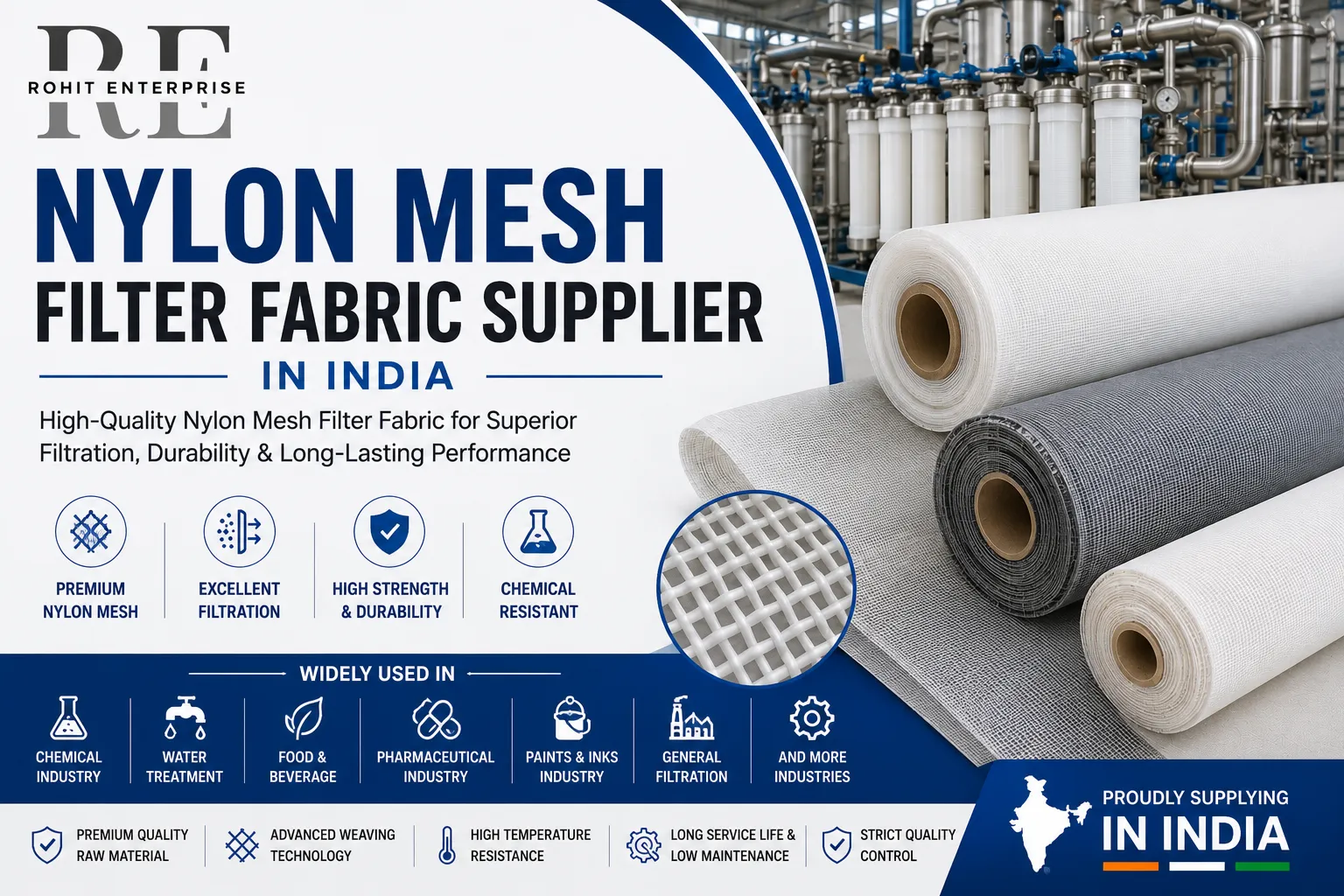
Nylon mesh filter fabric is a high-strength technical textile used for solid-liquid separation in centrifuges, filter presses and other process equipment. When the fabric lacks dimensional stability, tears under load or does not release the cake cleanly, filtration efficiency drops and maintenance costs rise. As a specialised nylon mesh filter fabric supplier in India, Rohit Enterprises has been producing precision nylon filter media since 1998 from our facility in Ankleshwar, Gujarat. We focus on fabrics that deliver reliable particle retention, excellent mechanical strength and long service life under real operating conditions.
Plant engineers who specify nylon mesh know that yarn quality, weave density and surface finish decide how well the fabric withstands abrasion, flexing and chemical exposure. That practical performance is what we engineer into every supply.
Nylon mesh filter fabric is a woven technical textile made from polyamide yarns. It is used as the primary filtration medium in equipment where high tensile strength, good abrasion resistance and controlled permeability are required. Liquid passes through the mesh while solids are retained on the surface or within the weave structure.
Nylon mesh provides a durable, flexible filtration surface that can handle mechanical stress better than many other synthetic fabrics. It is particularly valued in applications involving scraper discharge, high-speed centrifuges or abrasive slurries where fabric longevity is critical. The principles of textile-based solid-liquid separation are well established in process filtration engineering, as outlined in technical literature on solid-liquid filtration.
Inconsistent mesh opening leads to particle breakthrough or early blinding. Weak yarn or poor weaving results in premature tearing under tension or abrasion. Inadequate surface finish causes poor cake release and residual heel. These problems increase downtime, raise media replacement costs and affect filtrate quality. Correctly engineered nylon mesh removes those variables.
Rohit Enterprises supplies nylon mesh filter fabric in a range of weaves, micron ratings and surface finishes suitable for industrial filtration duties.
Monofilament nylon mesh offers precise, uniform openings and excellent cake release. Multifilament constructions provide higher strength and dirt-holding capacity. Both can be supplied according to the particle size and mechanical demands of the process.
Calendered or singed surfaces improve cake discharge and reduce particle embedding. Antistatic versions are available when static control is required for powder or solvent-based applications.
We start with the equipment type, required micron rating, slurry characteristics and mechanical stresses involved. Weave, yarn type and finish are then matched to those requirements.
Nylon yarns are selected for tensile strength and chemical resistance. Weaving is controlled to maintain uniform mesh openings and consistent permeability across the fabric width. This uniformity is essential for predictable filtration performance.
The fabric is converted into centrifuge bags, filter press cloths, filter panels and other made-up products to exact equipment dimensions. Edges, seams and fastening methods are finished to suit the specific machine design.
Finished fabric and converted products are inspected for dimensional accuracy, mesh uniformity and surface finish. Material documentation is provided when required by the customer’s quality system.
Longer media life is the most visible benefit. Nylon’s inherent abrasion resistance and tensile strength allow the fabric to survive more cycles than many alternative materials in demanding applications.
Smooth monofilament surfaces and appropriate finishes promote cleaner cake discharge. This reduces residual heel, shortens cleaning cycles and helps maintain lower pressure drop over successive batches.
Precise mesh openings deliver consistent filtrate clarity. This protects downstream equipment and supports product quality targets in regulated processes.
Although nylon mesh may have a higher unit cost than some alternatives, its longer service life and lower change-out frequency often result in lower overall operating cost.
Our process begins with the application details — equipment type, particle size, chemical environment and mechanical demands. Fabric is selected or woven accordingly and converted under controlled conditions.
Weaving, finishing and conversion follow defined procedures so that every batch performs consistently. Finished material is checked for mesh accuracy, strength and surface quality before packing.
Non-standard sizes, special edge constructions and made-up products for older or custom machines are produced regularly without treating them as special projects that delay delivery.
Nylon mesh is used in centrifuges and filter presses for intermediate and product recovery where mechanical strength and cleanability are important.
Chemical plants specify nylon mesh for abrasive or high-tension applications where fabric durability directly affects uptime.
Certain food and process applications use nylon mesh when strength, flexibility and controlled permeability are required.
We ask for the equipment type, required micron rating, slurry characteristics and current media problems. That information allows us to recommend a nylon mesh construction that addresses the real constraint rather than a generic stock item.
Quality is measured by how the fabric performs after repeated cycles, not by marketing claims. Technical discussion covers weave options, surface finishes and expected life so the plant can plan media changes properly.
Lead times are stated clearly. Pricing remains competitive for the performance delivered. Customer satisfaction comes from fabric that installs correctly, filters effectively and lasts as expected.
Provide the equipment type (centrifuge, filter press, etc.), required micron rating or particle size, slurry characteristics, operating temperature, and any problems experienced with existing media such as early tearing, poor cake release or particle breakthrough.
Sample fabric or made-up products can be supplied for process trials when needed. Once the construction is confirmed, regular supply is arranged with clear identification and packaging.
A reliable nylon mesh filter fabric supplier in India is defined by how consistently the fabric performs inside working filtration equipment, not by catalogue descriptions. Rohit Enterprises has focused on industrial filtration media, including high-strength nylon mesh, since 1998. From monofilament and multifilament constructions for centrifuges and filter presses to custom-converted products for specialised process equipment, the goal remains the same: precise particle retention, excellent mechanical durability and reduced process interruptions.
If your current nylon mesh is tearing early, giving inconsistent clarity or requiring frequent replacement, send the process details. We will respond with a clear technical recommendation and a straightforward commercial offer.
Rohit Enterprises is located in the industrial city of Ankleshwar in hearts of Gujarat. Established in the year 1998. jarat. Founded by Mr. Chandan Singh Kokliyal