
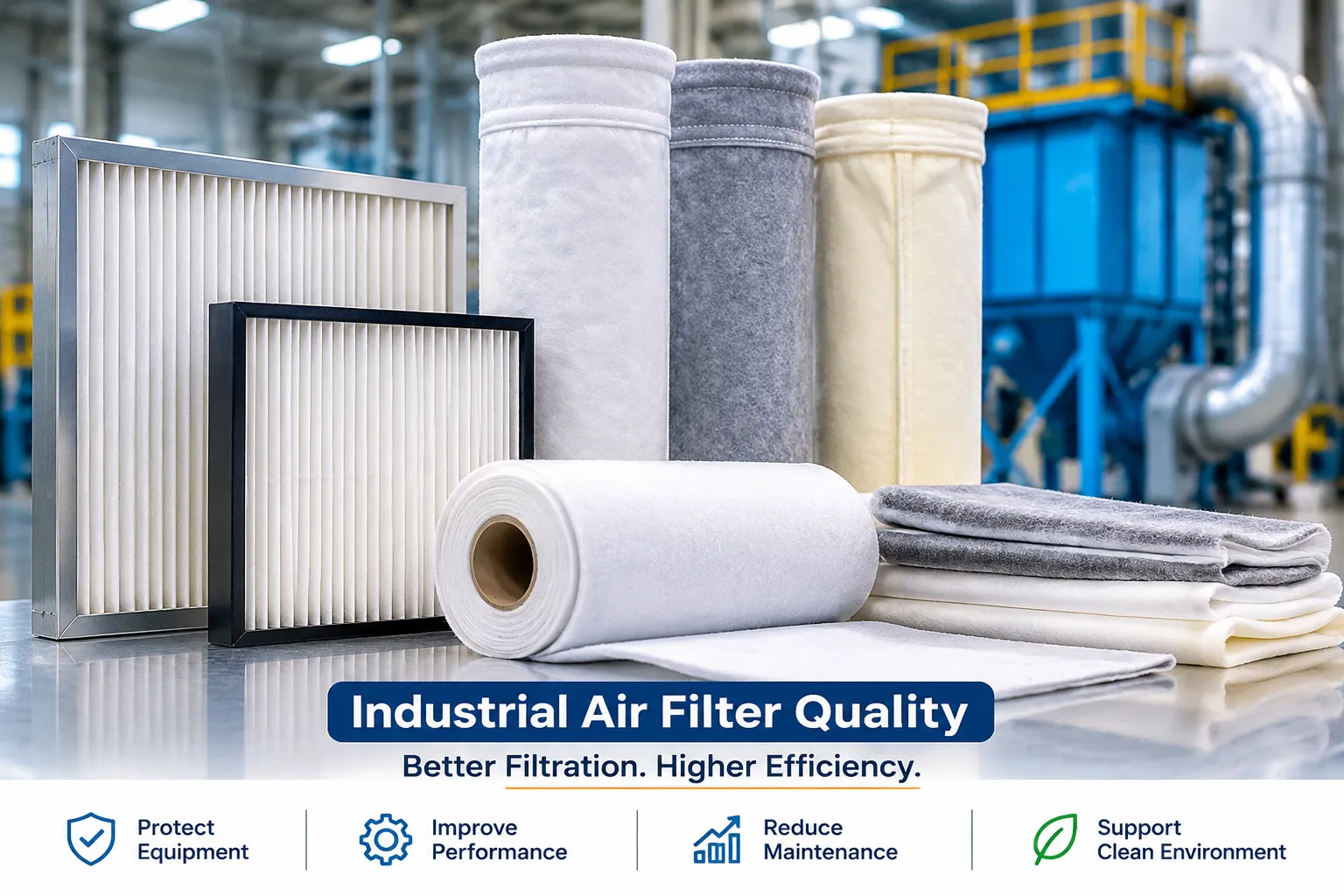
Industrial air filters play an important role in maintaining efficient operations across manufacturing facilities. From controlling airborne dust to protecting industrial equipment, the quality of filtration components can directly influence how consistently a filtration system performs. Choosing the right filter is not simply about installing a replacement component; it involves understanding the material, construction, operating conditions and filtration requirements of the application.
Poor-quality or incorrectly selected filters may contribute to frequent replacements, increased pressure drop, inadequate dust collection and unnecessary maintenance interruptions. On the other hand, properly selected industrial air filters can support stable airflow, effective particulate collection and dependable equipment operation.
Understanding how industrial air filter quality influences production efficiency helps plant managers, maintenance engineers and purchase professionals make better filtration decisions.
Industrial air filter quality should be evaluated based on filtration efficiency, material durability, airflow resistance and compatibility with the operating environment.
Why Industrial Air Filter Quality Matters in Manufacturing Operations
Industrial filtration systems operate under different conditions depending on the manufacturing process. Some facilities handle fine powders, while others deal with abrasive dust, chemical particles, high temperatures or continuous production loads.
The quality and suitability of the filter media influence how effectively these contaminants are captured and how consistently the filtration system operates.
Here are some important reasons why filter quality matters:
- Consistent filtration performance: Suitable filter media helps maintain effective particulate collection under specified operating conditions.
- Equipment protection: Proper filtration helps reduce dust accumulation on machinery, fans, motors and other industrial components.
- Stable airflow: Appropriate filter permeability and dust-loading characteristics help support the required airflow through the system.
- Reduced maintenance requirements: Durable and application-compatible filters can help minimise premature damage and unnecessary replacement.
- Reliable production operations: A properly functioning filtration system helps reduce filtration-related interruptions during manufacturing activities.
Selecting an industrial air filter according to its actual application is therefore an important part of maintaining efficient industrial operations.
7 Ways Industrial Air Filter Quality Impacts Production Efficiency
Filter quality affects several aspects of industrial filtration performance. Understanding these factors helps businesses identify suitable filtration components for their operating requirements.
1. Filtration Efficiency and Dust Collection Performance
One of the primary functions of an industrial air filter is to capture airborne particles from the process air stream.
The filter media, fibre structure, surface characteristics and construction influence how particles are collected. An unsuitable filter may allow excessive particle penetration or fail to perform consistently under the required operating conditions.
Effective filtration helps industrial facilities control dust generated during material handling, grinding, mixing, cutting and other production processes.
For this reason, businesses should evaluate filtration efficiency according to the particle size, dust characteristics and performance requirements of their applications rather than relying only on general product descriptions.
2. Airflow and Pressure Drop
Airflow is an important factor in the performance of an industrial filtration system.
When filter media becomes heavily loaded with dust or has unsuitable permeability, resistance to airflow can increase. This may result in higher differential pressure across the filter elements.
An increased pressure drop can affect fan performance and increase energy requirements to maintain the desired airflow.
Suitable filter media should provide an appropriate balance between particulate collection, air permeability and dust-loading characteristics.
Monitoring differential pressure regularly can help maintenance teams identify changes in filter performance and determine whether cleaning, inspection or replacement is required.
For additional technical guidance on industrial ventilation and airflow control, businesses can refer to the Occupational Safety and Health Administration (OSHA) resources on workplace ventilation.
3. Equipment Protection and Operational Reliability
Airborne dust can accumulate on industrial machinery, electrical components, motors, fans and other equipment when filtration is inadequate.
Over time, excessive dust accumulation may contribute to additional cleaning requirements, restricted ventilation or maintenance concerns.
Appropriate industrial filtration helps control airborne particles and reduce the amount of unwanted dust entering sensitive areas of a facility.
The right filter selection is particularly important in manufacturing environments where equipment operates continuously or where dust-sensitive components are involved.
4. Filter Durability and Replacement Frequency
Filter durability is another important consideration when evaluating industrial air filter quality.
Filters operating in demanding environments may experience mechanical stress, abrasion, temperature variations, chemical exposure and repeated cleaning cycles.
If the filter material or construction is unsuitable, premature wear, fabric damage, seam failure or leakage may occur.
High-quality filtration components should be selected according to:
- Operating temperature and temperature fluctuations.
- Chemical compatibility with the process environment.
- Mechanical strength and dimensional stability.
- Resistance to abrasion where required.
- Compatibility with the dust collector cleaning mechanism.
- Appropriate construction and installation requirements.
Choosing suitable filter media can help reduce avoidable replacement problems and support more predictable maintenance planning.
5. Reduced Production Interruptions
Manufacturing operations often depend on filtration systems to maintain suitable process and workplace conditions.
When filters become damaged, clogged or unsuitable for the application, maintenance teams may need to investigate the issue, replace filter elements or adjust system operations.
Frequent filtration-related maintenance can create additional work for production and maintenance departments.
Selecting suitable filter materials and monitoring their performance helps businesses identify potential issues before they develop into larger operational problems.
6. Energy Consumption and Operating Costs
Industrial filtration systems use fans and blowers to move air through the filter elements.
The resistance created by the filtration media and accumulated dust affects the pressure requirements of the system.
If the pressure drop becomes excessively high, the fan may require additional energy to maintain the necessary airflow, depending on the system design and operating controls.
The overall operating cost of filtration should therefore consider more than the initial purchase price of the filter.
Businesses should evaluate:
- Initial filter purchase cost.
- Expected operating life under actual conditions.
- Pressure-drop behaviour.
- Cleaning requirements.
- Replacement frequency.
- Maintenance and labour requirements.
This approach helps industrial buyers assess the total cost of filtration rather than selecting products based only on the lowest purchase price.
7. Consistency Across Production Processes
Industrial processes often require consistent environmental and operating conditions.
Changes in dust collection performance, airflow or filtration efficiency may affect housekeeping, process cleanliness and equipment operation.
Using application-appropriate filtration components and maintaining them according to operating requirements helps support more consistent filtration performance.
For industries handling fine powders, chemicals or specialised materials, filter selection should also consider process-specific safety and contamination-control requirements.
How to Identify High-Quality Industrial Air Filters
Not all industrial air filters are manufactured for the same operating conditions. Their suitability depends on the filtration material, construction, application and technical specifications.
Businesses evaluating industrial air filter quality should consider the following characteristics.
1. Suitable Filter Media
Filter media determines several important filtration characteristics, including particle collection, airflow resistance, chemical compatibility and operating temperature suitability.
Common industrial filter materials include:
Polyester Filter Media
Polyester is widely used in general industrial filtration applications. It offers useful mechanical strength and dimensional stability when selected within its operating limitations.
Polypropylene Filter Media
Polypropylene may be suitable for applications requiring resistance to various acids and alkalis. Its chemical compatibility and temperature limitations should be evaluated for the specific process.
Acrylic Filter Media
Acrylic filter media is considered for selected industrial environments where its chemical and operating characteristics match the application requirements.
Antistatic Filter Media
Antistatic filter media is used in applications where controlling electrostatic charge is important. Its suitability depends on the material construction, electrical properties and the overall safety design of the system.
2. Fabric Construction and Mechanical Strength
The construction of the filter fabric influences its durability and suitability for industrial applications.
Important considerations include:
- Fabric weight and thickness.
- Fibre composition.
- Weaving or nonwoven construction.
- Tensile strength.
- Dimensional stability.
- Surface finish.
- Seam strength and stitching quality.
These characteristics should be evaluated according to the filtration equipment and actual operating conditions.
3. Temperature and Chemical Resistance
Industrial filtration environments may expose filter elements to elevated temperatures, moisture, process gases and chemical substances.
A filter material that performs well in one application may not be suitable for another.
Before selecting filter media, businesses should identify the continuous operating temperature, peak temperature, moisture levels and chemical composition of the process environment.
4. Compatibility with Dust Collector Systems
The filter must be compatible with the design and operation of the dust collector.
For example, pulse-jet, reverse-air and mechanical shaker systems use different cleaning arrangements. Filter elements should be designed to withstand the mechanical conditions associated with their respective cleaning cycles.
Correct dimensions, mounting arrangements, sealing and construction are also important for preventing installation problems and filter leakage.
Common Problems Caused by Poor Industrial Air Filter Selection
Incorrect filter selection can create performance problems even when the filtration equipment itself is properly installed.
Some common issues include:
Frequent Filter Clogging
Unsuitable filter permeability, excessive dust loading or moisture-related problems can contribute to rapid filter blockage.
High Differential Pressure
An increase in pressure drop may indicate excessive dust accumulation, inadequate cleaning or unsuitable filter media.
Premature Filter Damage
Chemical incompatibility, excessive temperature, abrasion and mechanical stress can contribute to early filter failure.
Dust Leakage
Damaged filter fabric, poor seams, incorrect dimensions or improper installation can allow dust to escape from the filtration system.
Increased Maintenance Requirements
Repeated cleaning, inspection and replacement can increase maintenance workload and affect production planning.
Identifying the actual cause of these problems is important before selecting replacement filters. Simply replacing a damaged filter with another filter of the same material may not resolve an underlying application or operating issue.
Businesses can also refer to the local exhaust ventilation guidance for controlling workplace dust and fumes published by the UK Health and Safety Executive.
How to Choose the Right Industrial Air Filter for Your Facility
Selecting a suitable industrial air filter requires evaluating the complete filtration application.
Purchase managers and maintenance engineers should consider the following points before finalising a filter specification.
Understand the Type of Dust or Contaminant
Identify whether the application involves fine powder, coarse dust, abrasive particles, chemical substances or other process contaminants.
Evaluate Operating Temperature
Check the normal operating temperature and any temporary temperature peaks that the filter may experience.
Check Chemical Compatibility
Evaluate the filter material against the process gases, chemicals, moisture and other environmental conditions.
Review Airflow and Filtration Requirements
Consider the required airflow, filtration velocity, available filter area and acceptable pressure-drop range.
Select the Appropriate Filter Construction
Confirm the required dimensions, fabric construction, surface treatment, stitching, sealing and mounting arrangement.
Consider Cleaning and Maintenance Requirements
Select filter elements that are compatible with the cleaning mechanism and maintenance procedures of the dust collector.
Evaluate Long-Term Operating Performance
Compare filter options based on durability, filtration requirements, maintenance needs and total operating costs rather than purchase price alone.
Businesses that want to understand industry-specific filtration requirements can also read our guide on Industrial Air Filtration in Chemical, Pharmaceutical and Manufacturing Industries.
Why Choose the Right Industrial Air Filter Manufacturer?
The quality of an industrial air filter depends not only on the raw material but also on its manufacturing process, construction accuracy and suitability for the intended application.
Working with an experienced manufacturer can help businesses evaluate technical requirements and identify suitable filter media and constructions.
When evaluating an industrial air filter manufacturer, consider:
- Experience in industrial filtration applications.
- Availability of different technical filter materials.
- Ability to manufacture customised filter bags.
- Understanding of temperature and chemical requirements.
- Dimensional accuracy and construction quality.
- Support in selecting suitable filter media.
- Consistency in product specifications.
Businesses looking for dependable filtration products can explore Industrial Air Filter Manufacturers in India to understand available industrial filtration materials and manufacturing solutions.
Industrial Filtration Products and Solutions from Rohit Enterprises
Rohit Enterprises has been involved in industrial filtration media manufacturing and supply since 1998, serving businesses across different industrial sectors.
Based in Ankleshwar, Gujarat, the company provides filtration materials and customised filter constructions for applications requiring appropriate dust collection and industrial air filtration.
Its product range includes:
- Polyester filter media.
- Polypropylene filter media.
- Acrylic filter media.
- Antistatic filter media.
- Industrial filter fabrics.
- Dust collector filter bags.
- Customised filtration products.
Different industrial applications require different filtration characteristics. Rohit Enterprises considers factors such as material compatibility, operating temperature, dust characteristics, fabric specifications and filtration equipment requirements when evaluating suitable filtration solutions.
For businesses looking for application-specific filtration products, selecting the appropriate filter material and construction is an important step towards maintaining dependable filtration performance.
Frequently Asked Questions About Industrial Air Filter Quality
1. Why is industrial air filter quality important?
Industrial air filter quality influences particulate collection, airflow resistance, filter durability and maintenance requirements. Suitable filters help industrial facilities maintain effective filtration and protect equipment from excessive dust accumulation.
2. How does air filter quality affect production efficiency?
Appropriate filter quality helps maintain consistent filtration performance, suitable airflow and effective dust collection. It can also help reduce premature filter failures and unnecessary maintenance interruptions.
3. What are the characteristics of a high-quality industrial air filter?
Important characteristics include suitable filtration efficiency, appropriate air permeability, mechanical strength, temperature resistance, chemical compatibility and construction quality. The required characteristics depend on the intended application.
4. Which material is best for industrial air filters?
There is no single material suitable for every industrial application. Polyester, polypropylene, acrylic and antistatic filter media are selected according to operating temperature, chemical exposure, dust characteristics and cleaning requirements.
5. Can poor-quality air filters increase maintenance costs?
Yes. Unsuitable or prematurely damaged filters may require frequent inspection, cleaning and replacement. Increased pressure drop and filter leakage can also create additional maintenance concerns.
6. How can I improve the performance of an industrial air filtration system?
Monitor differential pressure, inspect filter elements regularly, maintain the cleaning system, evaluate airflow and replace damaged filters. It is also important to ensure that the selected filter media matches the actual operating conditions.
7. How often should industrial air filters be replaced?
Replacement frequency depends on operating conditions, dust loading, filter material, cleaning cycles and the condition of the filter elements. Regular inspection and differential pressure monitoring help determine the appropriate replacement time.
8. What should I check before purchasing industrial air filters?
Check the filter dimensions, material composition, operating temperature, chemical compatibility, filtration requirements, air permeability, cleaning mechanism and construction specifications. These details help ensure that the filter is suitable for your equipment and process.
Conclusion
Industrial air filter quality is an important factor in maintaining filtration performance, protecting industrial equipment and supporting consistent manufacturing operations.
Maintaining industrial air filter quality through proper material selection, regular inspection and timely replacement can help businesses achieve more reliable filtration performance.
From filtration efficiency and airflow to filter durability and maintenance requirements, every aspect of filter selection can influence the overall performance of an industrial filtration system.
Choosing the right filter requires understanding the application, evaluating the operating environment and selecting appropriate filter media and construction.
Rohit Enterprises, with experience in industrial filtration media since 1998, supports different industrial requirements through technical filter materials and customised filtration products.
For businesses evaluating filtration requirements, selecting suitable industrial air filters is an important investment in dependable equipment performance and efficient production operations.